
Startup Business: From Idea to Venture Capital Readiness
Course Level: Bachelor’s Degree
Course Duration: 15 weeks
Course Format
- Weekly sessions combining lecture, workshop, and mentoring
- Team-based work (2–3 students per team)
- Optional inclusion of 1–2 external contributors (outside the course or the university)
- Continuous weekly reporting and milestone-based evaluation
- Practice-oriented, execution-focused learning approach
Course Concept and Positioning
This course is designed as a practical, accelerator-style program that simulates the early stages of a real startup journey.
Its main objective is to guide students from idea generation to venture capital readiness, following the logic, expectations, and evaluation criteria commonly applied by venture capital fund managers, accelerators, and early-stage investors.
Throughout the course, students work in startup teams and progressively build, validate, and refine their ideas through real market interaction, experimentation, and structured feedback.
By the end of the course, student teams are expected to reach a level of maturity that allows them to credibly apply for pre-seed or seed funding, or to engage in professional discussions with venture capital investors, accelerators, and innovation programs.
Course Objectives
By the end of the course, students will be able to:
- Identify and formulate real, market-relevant entrepreneurial problems
- Develop and validate scalable startup ideas
- Apply structured customer discovery and validation methods
- Design value propositions and business models suitable for early-stage ventures
- Build and test minimum viable products (MVPs) or prototypes
- Develop initial go-to-market strategies
- Prepare financial projections and investment rationales
- Create a complete investor-ready startup package
- Present and defend startup ideas in an investor-style pitch format
Learning Outcomes
Upon successful completion of the course, students will have achieved the following learning outcomes, in line with the European Credit Transfer and Accumulation System (ECTS):
Knowledge
Students will be able to:
- Explain the startup lifecycle from ideation to early-stage financing
- Describe key concepts related to entrepreneurship, venture capital, and innovation ecosystems
- Understand different startup business models, validation techniques, and funding mechanisms
- Recognize investor expectations at the pre-seed and seed stages
Skills
Students will be able to:
- Apply problem identification and opportunity recognition techniques
- Conduct customer interviews and market validation
- Design and test MVPs and prototypes
- Analyze competitive landscapes and define differentiation strategies
- Develop basic financial models and pricing logic
- Prepare professional pitch decks, one-pagers, and data rooms
- Communicate startup ideas clearly to investor and stakeholder audiences
Competences
Students will demonstrate the ability to:
- Work effectively in multidisciplinary entrepreneurial teams
- Take initiative and manage uncertainty in early-stage venture development
- Make evidence-based decisions under limited information
- Integrate market feedback into iterative business development
- Present, defend, and refine entrepreneurial ideas in professional and critical settings
- Align startup development efforts with real-world investment criteria
Weekly Program Overview (High-Level)
- Weeks 1–2: Idea generation, team formation, problem definition
- Weeks 3–4: Customer discovery and validation
- Weeks 5–6: Value proposition, competitive analysis, business model
- Weeks 7–8: MVP definition and prototyping
- Weeks 9–10: Go-to-market strategy and traction experiments
- Weeks 11–12: Financials, investment logic, pitch preparation
- Final Weeks: Demo Day and investor-style pitching
A detailed week-by-week task list, including specific objectives and deliverables, is provided to students throughout the course.
Lectures and Learning Materials
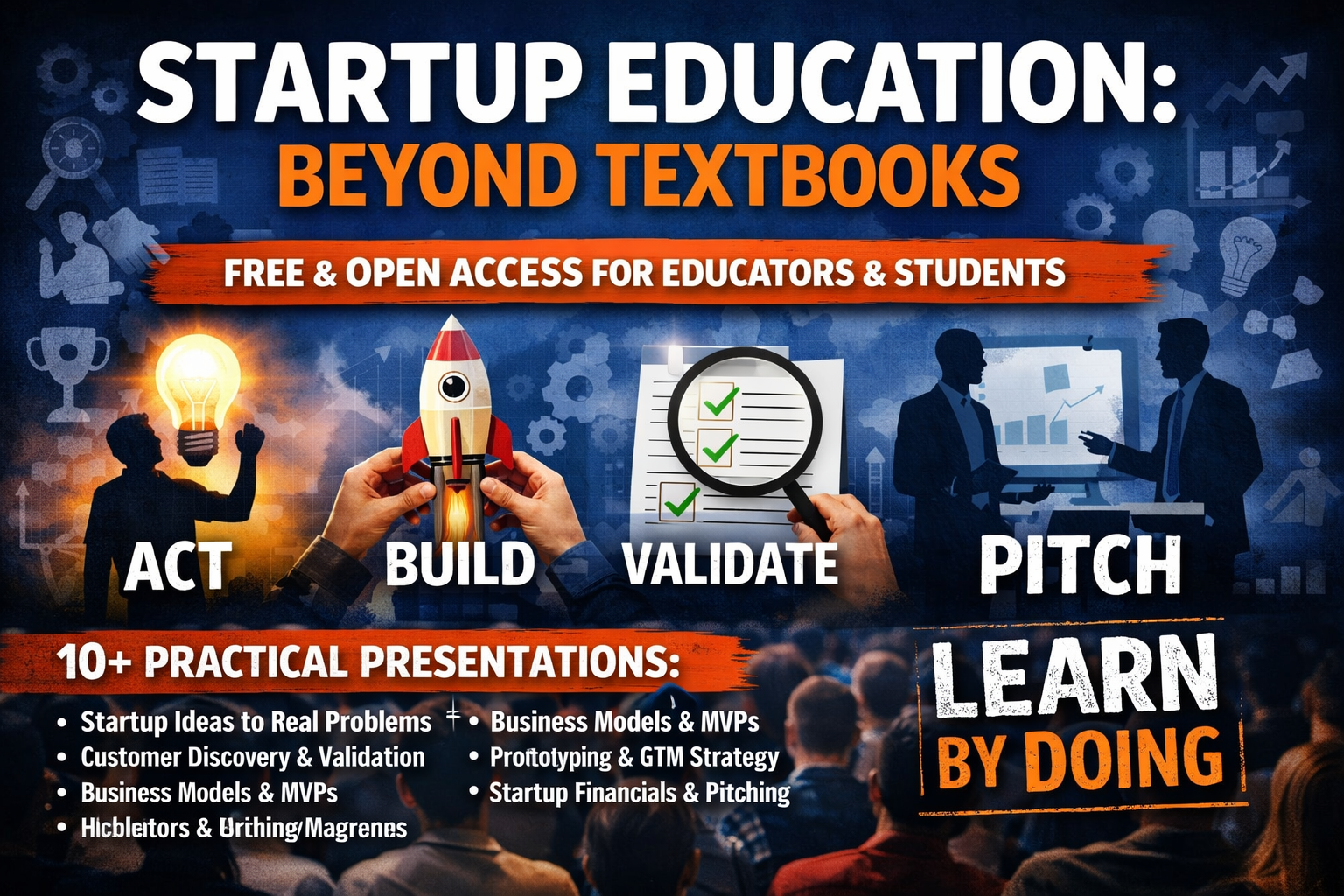
The course is supported by downloadable presentations covering the following topics:
- From Startup Ideas to Real Market Problems
- Customer Discovery and Problem Validation for Startups
- Designing the Value Proposition and Business Model for Startups
- MVP Development, Prototyping, and Go-To-Market Strategy for Startups
- Startup Financials, Investments, and Pitching
- Business Models for Startups
- Startup Validation: Methods, Metrics, and Evidence
- Prototyping and MVP Strategies for Startups
- Pricing and Revenue Models for Startups
- From Prototype to Traction for Early-Stage Startups
Assignments and Weekly Reporting
Structured weekly reporting templates and assignments mapped to each topic and presentation form an essential part of the course methodology.
These materials support:
- systematic progress tracking,
- continuous learning and iteration,
- alignment with professional startup and investor standards.
Weekly report templates and detailed assignment briefs are provided to enrolled students and are available upon request.